Best Social Selling Platforms: The Key to E-Commerce Marketing Success
In today’s fast-paced digital age, selling has evolved beyond traditional techniques. Brands are moving into social media, and from there, a new term has emerged – Social Selling. It is the new buzzword, and for all the right reasons. With the rise of the best social selling platforms, businesses can now engage with their audience, build trust, and drive sales more effectively through personalized interactions on social media.
In this blog, we will explore the meaning, importance, and benefits of this term. Whether you are a business owner or an e-commerce marketer, this blog will help you understand why it is critical to your e-commerce marketing success.
So, buckle up, and let’s dive into the chapters of social selling!
What is Social Selling?
Social selling is the process of using social content to develop trust and awareness among potential customers, with the ultimate goal of converting them into actual buyers. It differs from traditional selling in several key ways.
It is often a more collaborative process where sellers work with marketing teams and tools in order to enable customers to shop for products from their e-commerce stores through embedded social content.
Social media plays a critical role in social selling. Social sellers can build stronger relationships, reach more prospects, and drive more sales by effectively leveraging social media content.


Benefits of Social Selling
Social media’s impact has revolutionized how people interact, develop relationships, and make decisions. This technologically sound era has also given rise to various new social phenomena, such as social selling.
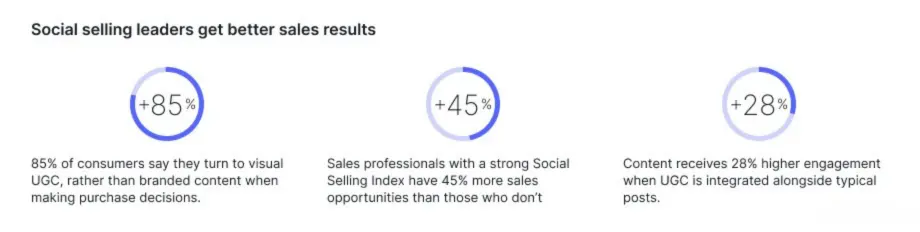
Researchers say 61% of organizations engaged in social selling report revenue growth.
And that’s not it. There is a multitude of benefits to including this phenomenon in your business strategy. Continue reading!
1. Enhanced personal branding and thought leadership
One of the key benefits of social selling is the opportunity to enhance personal branding and thought leadership.
Personal branding refers to establishing a unique and consistent image of oneself to others, which can be accomplished by leveraging carefully curated social content to its potential.
Statistically speaking, 78% of businesses that use social selling outperform those that don’t.
This increase in performance also allows businesses to establish themselves as leaders. By consistently utilizing visual social content, social sellers can present their brand principles and USPs to potential customers.
This helps build credibility and trust, which is essential for establishing and maintaining relationships with potential customers.
2. Higher conversion rates and revenue growth
Establishing a significant presence on social media platforms is not all. There is another blend of powerful potions that can more prominently lead to higher conversion rates and revenue growth.
The combination of social selling and UGC. UGC is a trusted source of social proof of a brand’s quality and value. By including UGC, social sellers can better understand what customers like and dislike about a product or service and use that information to tailor their product galleries and offerings to meet customer needs better.
Sales professionals who use social selling close 40-50% more new business than those who don’t.
By leveraging UGC effectively, social sellers can build stronger customer relationships, increase sales, and drive business growth.
3. Improved customer engagement and relationship-building
It can contribute to improved customer engagement and relationship-building. As stated above, user-generated content is crucial for reaching the best potential of social selling.
Social sellers can demonstrate their commitment to customer service and build rapport with potential customers by responding to comments and messages and showcasing user-created shoppable content on their eCommerce stores.
Visitors spend 90% more time on websites that include UGC galleries.
Social sellers can build a loyal following and foster a sense of brand affinity by sharing content and engaging with customers more directly.
4. Increased Brand Visibility & Awareness
Social selling can significantly increase a brand’s visibility and awareness among its target audience. By leveraging social content – be it UGC or branded content- sales professionals can reach out to prospects and engage with them through relevant and personalized content.
Additionally, it offers sales professionals opportunities to share content promoting the brand and its products/services to a more varied audience.
77% of shoppers are more likely to buy a product they found through UGC.
This, in turn, leads to more sales and awareness for the brand as it gains exposure to a wider audience.
Tips & Best Practices to Implement Social Selling
Implementing social selling strategies can be a game-changer for businesses, but it requires more effective strategies and an understanding of the e-commerce sphere.
Statistically speaking, businesses prioritizing social selling are 51% more likely to reach their sales quota.
Here are some tips for eCommerce marketers to implement:
1. Use Analytics to measure Success:
Using analytics to measure success is a critical best practice when implementing social selling strategies.
Analytics tools can help sales teams track and measure the impact of their eCommerce activities, identify improvement areas, and optimize their strategies for maximum impact. Additionally, solid communication through an internal communication platform ensures that insights and strategies are effectively shared and implemented across the team.
This information can also help brands understand which social media platforms are most effective for engaging potential customers, which types of content drive engagement, and which strategies are most effective for generating leads and closing sales.
2. Share Authentic Content:
Buyers today are looking for unbiased and genuine connections with brands, and sharing authentic content can help to establish trust and build relationships with potential customers.
Sharing relevant and valuable content to their target audience can instantly amp up any business’s authenticity. It can speak of your brand’s principles and values and even help you boost brand awareness and visibility.
By sharing authenticity, you can collect more user-generated content from your existing audience and utilize it to create shoppable galleries and build a stronger social selling strategy.
3. Stay Up-to-date
It relies heavily on content creation and distribution, and it’s essential to provide your audience with valuable and relevant information that keeps them engaged and interested in your brand.
One way to keep your content fresh is by regularly researching your target audience and industry trends. This will help you create content that resonates with your audience and speaks to their pain points and challenges.
Another way to keep your content up-to-date is by leveraging various types of content, such as branded content, influencer content, and user-generated content. This can help you reach a wider audience and keep your content engaging and shareable.
Lastly, reviewing and updating your content regularly is important to ensure it remains relevant and valuable. Analyze your metrics and user feedback to identify which types of content resonate most with your audience and adapt your strategy accordingly. Keeping your content fresh and up-to-date can improve your social selling efforts and increase your chances of success.
4. Foster Meaningful Collaborations
Fostering meaningful collaborations is an essential practice when implementing social selling.
It is all about building relationships with customers, prospects, and industry influencers through social media channels. Collaborations with these groups can help you expand your reach, gain credibility, and establish yourself as a thought leader in your industry.
To foster meaningful collaborations, identify the individuals or organizations that align with your brand values and can provide value to your target audience. If you need help discovering and managing great partners, consider developing an effective influencer marketing strategy, as explained in the Influencer Marketing Expert Guide. By building and nurturing these relationships, you can create a network of supporters who can help amplify your brand message and drive sales.
5. Develop A Social Selling Inclusive Sales Strategy
Developing a sales strategy inclusive of social selling is essential to achieve the best results most effectively. To develop this strategy, you must first understand your target audience and their behavior on social media platforms and towards various social content formats.
This way, you can find out what your audience is most responsive to, and you can include those practices in your sales strategy. You can create a social media content plan that aligns with your overall sales strategy.
This plan should include relevant and engaging content that appeals to your target audience and showcases your brand’s products or services.
It is essential to know how to keep your audience engaged in the ever-changing nature of social media and to monitor the effectiveness of an e-commerce marketer who uses social media for sales.
This is when the Social Selling Index comes into play. Please continue reading to know more about it.
Social Selling Examples
1. Malandra:

Malandra is a fashion brand that focuses on handmade jewelry and accessories. The company has quickly become known for its unique and stylish designs. Malandra operates primarily through social media platforms such as Instagram, with over 150k followers. The brand has also established partnerships with influencers and bloggers, who help to promote its products and reach a wider audience.
Malandra uses social selling strategies to engage with its customers and create a sense of community around its brand. For example, the company often shares user-generated content on its Instagram page, featuring customers wearing its products and sharing their personal stories. Malandra then uses this content to boost website traffic and drive sales by turning social content into shoppable content.
2. Stella & Dot:

Stella & Dot is a direct sales company specializing in jewelry and accessories. Founded in 2004, the company has a network of over 50,000 independent stylists who sell its products through it. Stella & Dot uses powerful social content and adds it to product pages on their website to drive sales.
Stella & Dot’s social selling model is based on building personal relationships and providing a personalized shopping experience. The brand offers one-on-one consultations and helps customers select products that fit their style and preferences. The company also showcases authentic user-generated content to create a sense of customer inclusivity.
3. Cluse:

Cluse is a watch and jewelry brand that was founded in 2013. The company’s products are minimalist and stylish, focusing on affordable luxury. Cluse primarily sells its products through its website and social media platforms such as Instagram, where it has over 500k followers.
Cluse’s social selling strategy is based on creating a strong visual identity and engaging with its audience through powerful visual content. The company’s Instagram page features high-quality product photos and lifestyle images, creating a cohesive and aspirational brand image. Cluse also collaborates with influencers and bloggers, who help to promote its products and reach a wider audience.
4. Rodan + Fields:
Rodan + Fields is an American multi-level marketing company specializing in skincare products. The company’s products are sold through a network of over 300,000 independent consultants, who use socially inclusive sales strategies to promote and sell the brand.
The brand is tapping the potential of well-curated UGC by showcasing it on its eCommerce store in different formats, such as images and comprehensive product videos. The brand has turned this content shoppable as a part of its social selling strategy.
The brand has refined its social selling strategy, gained revenue, and increased website traffic.
6 Best Social Selling Platforms
1. Pixlee TurnTo
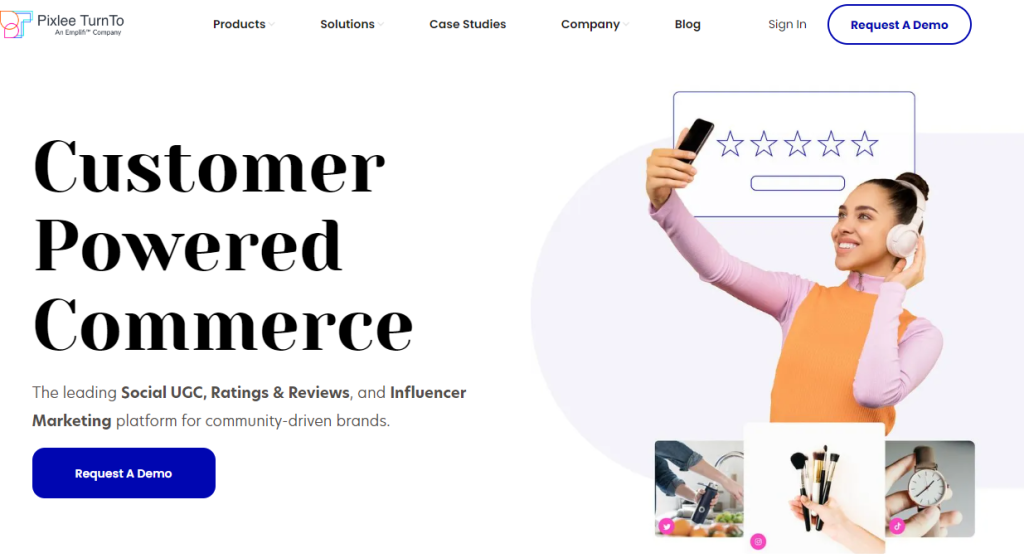
Pixlee TurnTo is a user-generated content platform that enables businesses to sell socially by helping businesses collect and curate customer photos and videos on social media.
Businesses can use this social selling tool to curate UGC featuring their products, and then display that UGC alongside product reviews and ratings. This can create a more immersive shopping experience, providing potential customers with social proof and authentic product information in one place.
Pixlee TurnTo also offers a shoppable gallery feature that allows businesses to showcase their products and link them to their e-commerce site, improving their conversion rates.
2. Tagembed
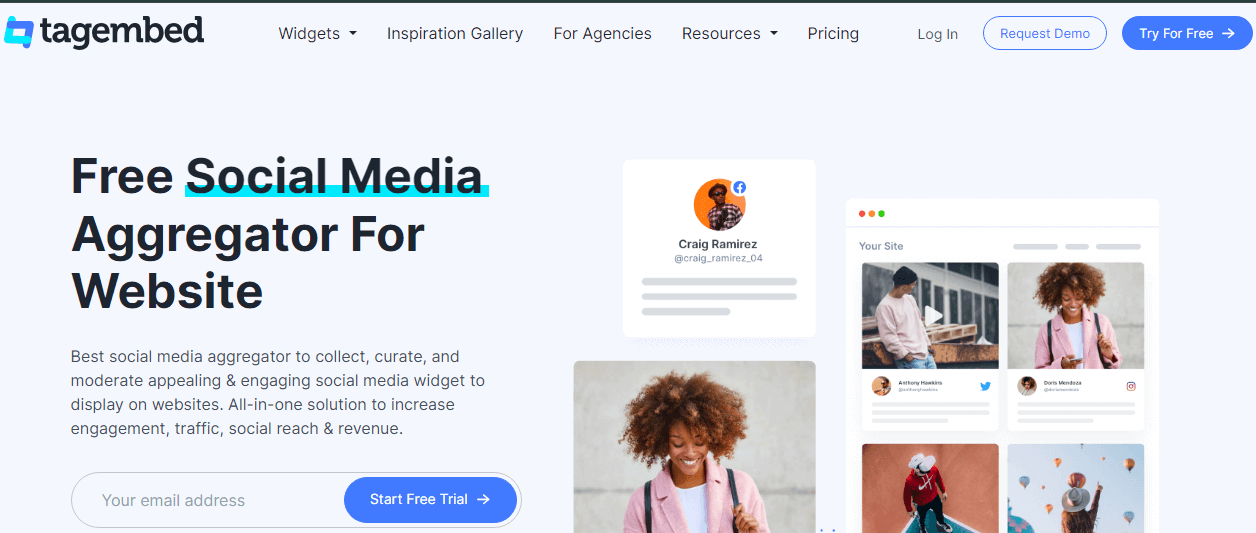
Tagembed is the best social selling platform, providing a way for businesses to turn their social content into a shoppable feed.
With Tagembed, businesses can easily add product tags to their social media posts and stories and allow customers to integrate this content into their eCommerce websites, homepages, product pages, or emails.
One of the key features of Tagembed is its simplicity. With Tagembed, businesses can easily set up their shoppable feed in just a few clicks, without any coding or technical expertise.
With its easy-to-use shoppable feed feature, seamless e-commerce integration, advanced analytics and reporting, and customization options, Tagembed provides businesses with everything they need to succeed with social selling.
3. Dash Hudson

Dash Hudson is a social selling platform that helps businesses to grow their online presence and drive sales through visual marketing.
The tool offers a range of efficient features, including content creation and curation tools. These tools enable businesses to create and manage visual content at scale, ensuring that their social media feeds and marketing campaigns feature a variety of high-quality visual content.
Dash Hudson offers integrations with various e-commerce platforms, including Shopify and WooCommerce. These integrations enable businesses to connect their social selling efforts with their online store, creating a seamless customer shopping experience.
4. Bazaarvoice
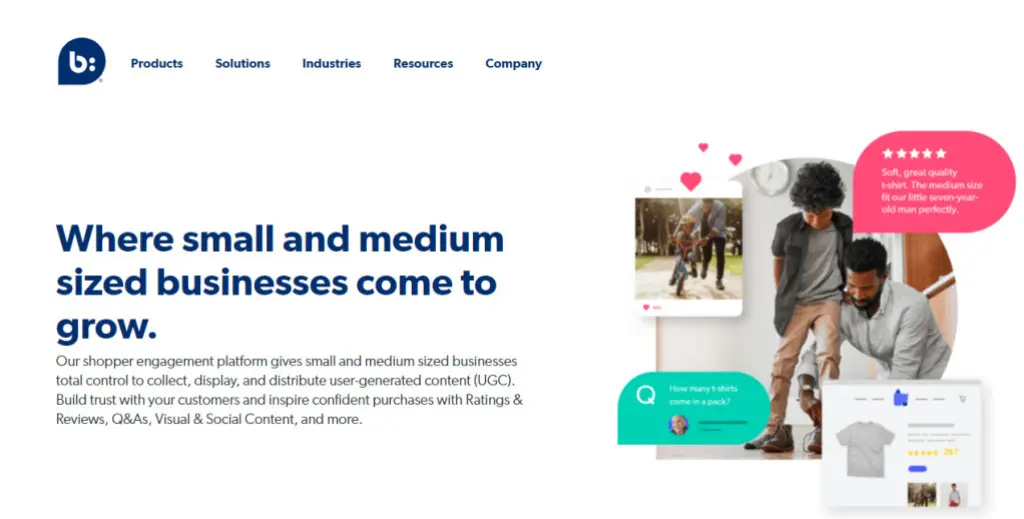
Bazaarvoice is a social selling platform that enables businesses to collect and leverage customer reviews and other user-generated content to drive sales.
Its ability to collect and syndicate customer reviews across a range of websites and channels, including social media, search engines, and e-commerce platforms, enables businesses to reach a wider audience and improve their online reputation.
In addition to that, the tool also has moderation and management features that allows businesses to manage the content seamlessly.
Bazaarvoice offers integrations with a range of popular e-commerce platforms. These integrations enable businesses to seamlessly incorporate customer reviews and other UGC into their online store, creating a more engaging and persuasive shopping experience for their customers.
5. Foursixty
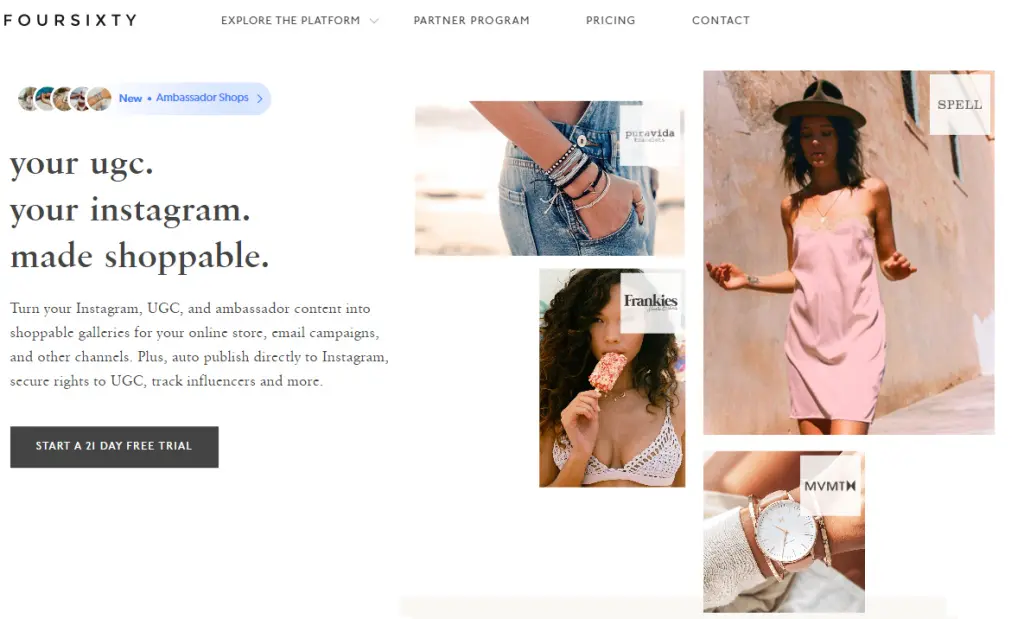
Foursixty is a social selling platform that provides businesses with a range of tools and features to create a seamless shopping experience for their customers, ultimately driving sales and increasing customer loyalty.
One of the key features of Foursixty is its ability to create a shoppable Instagram feed. With Foursixty, businesses can tag their products in Instagram posts and stories, allowing customers to easily click through to the product page and make a purchase.
In addition to its shoppable Instagram feed, Foursixty also has analytics and reporting tools, and offers customization options to create a unique and branded shopping experience.
6. Flowbox

Flowbox is another social selling platform that lets brands create shoppable UGC galleries.
It is a powerful sales and marketing tool that enables to collect and curate UGC from social media platforms like Instagram, Facebook, and Twitter. It allows users to utilize that content to create a more engaging and authentic shopping experience for their customers.
Flowbox also provides businesses with various customization options to create a unique and branded shopping experience.
How To Effectively Use Social Selling Platforms?
To effectively use social selling platforms, businesses should keep in mind the following tips:
1. Know Your Target Audience
The first step to effectively using social selling platforms is to understand your target audience. Businesses should take the time to research and identify their ideal customers’ interests, preferences, and pain points to create content that resonates with them.
By tailoring content to their audience’s needs and showcasing it compellingly, businesses can build a more meaningful connection with their followers and drive engagement, ultimately leading to more revenue and overall growth.
2. Provide Valuable Content
Providing valuable content is key to creating a strong brand presence on social media. Businesses should aim to create informative, engaging, and relevant content that adds value to their followers’ lives.
This can include showcasing authentic user-generated content or collaborating with popular influencers for high-quality content, product reviews, and customer success stories.
Social selling is about building relationships, and providing valuable content is key to achieving that. By sharing informative and relevant content, businesses can establish themselves as thought leaders and earn the trust of their audience.
3. Engage With Your Audience
Social media is a two-way conversation, and businesses should actively engage with their audience to build relationships.
This means staying responsive and posting content that your audience finds relatable and relevant. By creating a more personalized experience for their followers, businesses can touch base with customers and instill a sense of community in them.
4. Keep Performance’s Track
Social selling platforms provide analytics features that can help businesses track the performance of their social media campaigns, clicks on shoppable posts, and other actions taken by customers.
Businesses can gain insights into what content resonates with their audience and make data-driven decisions to optimize their strategy by measuring engagement metrics like reach, impressions, and clicks.
These metrics can help measure your efforts’ effectiveness and make data-driven decisions to optimize your strategy.
Conclusion
In conclusion, social selling has become crucial to modern marketing and sales strategies. By leveraging social content, businesses can build stronger relationships with their target audience, increase brand awareness, and drive more sales.
eCommerce marketers are expanding their horizons and welcoming new methods to examine their put-together strategies. Measuring metrics like Social Selling Index to measure the effectiveness of social selling and other social commerce tools to make their process smoother are now coming in force.
In addition to using the SSI, businesses can also incorporate user-generated content (UGC) into their strategies to build trust and credibility with prospects. UGC can also provide valuable insights into customer preferences and behaviors, helping businesses tailor their marketing strategy to meet their target audience’s needs better.
Social selling offers numerous benefits for businesses, including increased brand awareness, stronger customer relationships, and higher sales conversions. By leveraging the best social selling platforms and incorporating tools like the SSI and UGC into their strategies, businesses can effectively engage with prospects and build long-term, valuable relationships.
Embed social feed from Facebook, YouTube, Instagram, Twitter on your website, like a PRO
Invalid Email Address Multiple Themes