Facebook API: How To Get & Use It
Ever thought of integrating all of Facebook’s functionality and information into your website or app? It is possible with the help of the Facebook API. It may sound complex, but trust me, it’s way simpler when understood. Whether you are building your app or just want to share your engaging Facebook content on your website, the Facebook API has got you covered.
If you are confused about the process, complex coding, or manual updates while embedding, the Facebook API can address all these pain points and keep your website or app always up to date. Want to break down this fear of confusion? Read this blog to know everything:
What is the Facebook API?
Facebook API or Facebook Graph API (Application Programming Interface) is an HTTP-based API that allows developers to extract data from Facebook and integrate it into third-party applications.
There are many different versions of the Facebook API, such as conversion, live video, Instagram, marketing, pages, videos, and WhatsApp business APIs. By using the Facebook API, developers can create engaging and personalized applications, leveraging the platform’s reach to the next level.
Unlock the Power of Facebook API — Start Integrating Today!
Access user data, publish content, and harness Facebook’s tools to grow your business.
Types of Facebook API’s
Let us understand in detail the type of Facebook marketing APIs:

1) Conversion API
The conversion API allows apps to track web conversions, page visits, and other data for precise ad targeting, reporting, and getting audience insights. It provides an in-depth analysis of users and their performance, enabling brands to optimize the performance of their campaigns on Facebook Ad Manager.
2) Live Video API
This enables apps to stream live videos directly on Facebook’s user profiles, pages, and groups. You can easily broadcast, schedule, and interact with your audience using the live video API.
3) Instagram API
The Instagram API allows app users to publish posts, videos, manage comments, mentions, and share stories easily. Developers can easily interact with the Instagram platform and get access to the data.
4) Marketing API
Using the Facebook Marketing API, businesses can easily advertise their products and services on the Facebook Marketplace by automating ad management. You can also combine it with a Facebook widget to display ads or posts on your website and get relevant insights and metrics for optimization, custom dashboards, and more with the Facebook Ads API.
5) Video API
The Video API allows apps to publish videos on Facebook pages and groups and receive relevant insights on them as well.
6) WhatsApp Business API
Using WhatsApp Business API, businesses can communicate with their target audience by connecting various agents and bots via WhatsApp. With the help of this API, brands can respond quickly to customer queries and enhance their experience.
How to Get a Facebook API Key?
Here are the detailed steps for getting a Facebook API key:
1 – Go to the Facebook developer account, log in, or create your account.
2 – In the upper right corner of the main page, click on ‘Get Started’.
3 – Ensure your account is approved to proceed.
4 – Once your account is verified, read the documentation to get acquainted with all the terms and conditions.
5 – Now, you are creating your first app. All your Facebook APIs and app stats will be tracked in the developers’ dashboard, which can only be accessed after creating the app.
6 – Add the apps to your dashboard by selecting the ones you require.
7 – Now, go to ‘Tools’ and then ‘Graph API Explorer’ to generate an access token for the APIs that you would like to choose.
8 – Select the app and the kind of token you need from the drop-down menu. Then click ‘Generate Access Token’ and the account will approve the access to the app on your page.
With this process, you will easily be able to generate the Facebook API key of your account.
How to Use Facebook API?
Once your API access key is approved, you can use the Facebook API in the following ways:

1. Page Insights
Using the Facebook API, developers can easily access page insights, query data, and create powerful dashboards. This will help them understand the audience better, which in turn helps refine your page strategy.
2. Audience Insights
As mentioned above, the Facebook API can help you better understand your audience and provide more in-depth insights into them. Developers can easily collect user demographics, such as who visited their page and who engaged with the post.
3. Campaign Management
Facebook API lets you manage your ad campaigns effectively. You can easily monitor the relevant metrics such as visits, impressions, engagement rates, plus budget management, and get detailed reports for the same.
4. Post Live Videos
Facebook API lets you post live videos to groups, pages, and user timelines seamlessly. You can even broadcast, schedule, and interact with your audience via Live videos.
5. Embed Facebook & Instagram Feed
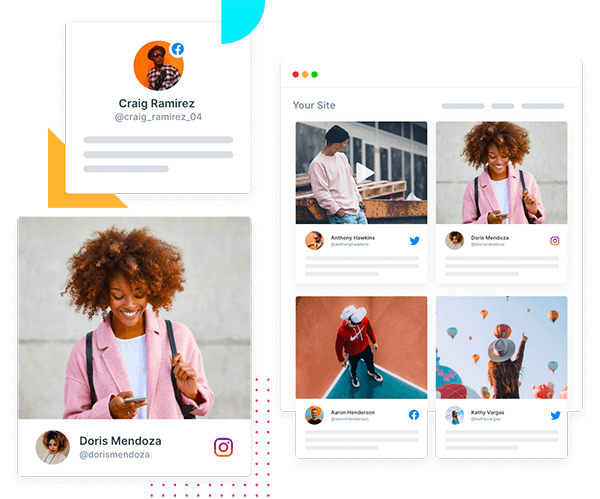
One can easily embed Facebook feeds and Instagram feeds on their applications and websites using the Facebook API. For example, you can easily display your user-generated content, such as reviews and testimonials, on your e-commerce site to build engagement.
6. Gather Competitive Insights
You can even get access and read public data for Facebook pages, such as public comments and posts that you are not an admin of. This helps you in gaining competitive analysis and benchmarking.
Facebook API Status Code and Errors
Facebook uses a range of status codes and error codes to communicate the outcome of the API request and provide information about any issues that may arise. Here is a list of status codes and errors:
| Error Code | Description | Typical Action |
| 1 | Unknown error | Retry or check for updates |
| 2 | Service temporarily unavailable | Retry later |
| 4 | Application request limit reached | Throttle requests, check rate limits |
| 10 | Permission denied | Check app/user permissions |
| 17 | User request limit reached | Throttle user actions |
| 190 | Invalid OAuth 2.0 Access Token | Refresh or re-authenticate |
| 200 | Permissions error (e.g., missing permissions for posting) | Check the required permissions for the action |
| 341 | Application limit reached | Wait and retry, check API usage |
| 368 | Temporarily blocked for policy violations | Wait and retry, review policy compliance |
| 506 | Duplicate Post | Change the post content and retry |
| 803 | Object not found | Check the object ID or existence |
| 458 | App Not Installed | The user must authenticate with the app15 |
| 459 | User Checkpointed | The user must log in and resolve the checkpoint |
There are other exceptional cases such as:
- OAuthException: Indicated authorization issues such as invalid tokens or permissions.
- Session Errors: Related to session timeout, expiry, or user log out.
- Data Errors: Related to data store constraints.
- Batch Errors: Related to batch API usage limits.
The End Note
Facebook API, though technical, has numerous benefits once you have access. You can gain marketing insights, stream live videos, embed a Facebook feed, and access Instagram as well. With the above steps, you can easily get access to the Facebook marketing API key; you just need to be careful with the technicalities for seamless approval. We hope that now you can easily generate an API key and avail yourself of its benefits.
However, if you are specifically looking for embedding the Facebook feed, I recommend using Tagbox. From having easy API integrations to seamless aggregation from social media platforms, the tool provides you with everything. Get started with it and grow the engagement of your website.
Embed social feed from Facebook, YouTube, Instagram, Twitter on your website, like a PRO
Invalid Email Address Multiple Themes