How To Embed LinkedIn Feed On Website (Complete Guide in 2026)
If your homepage looks exactly the same today as it did three months ago, visitors have picked up on that, even if they couldn’t tell you why. One of the easiest fixes is also one of the most overlooked: pull your LinkedIn activity onto your site so the page updates itself.
Most B2B brands already put their best material on LinkedIn. Product announcements, hiring news, leadership takes, customer wins. All of it sits inside the LinkedIn app doing basically nothing for your own website. Bring it over, and it starts earning its keep twice.
This guide walks through every real way to embed a LinkedIn feed on your website using a LinkedIn widget or LinkedIn’s native embed option, explains the limitations of each approach, and shows you how to set it up on WordPress, Shopify, Webflow, Wix, or a plain HTML site.
TL;DR
- Embed your LinkedIn feed to automatically display your latest posts and keep your website fresh.
- Use LinkedIn’s native embed for a single public post, or a feed aggregator for a live, auto-updating feed.
- A live LinkedIn feed boosts credibility, showcases company updates, and strengthens employer branding.
- Feed aggregators let you customize layouts, moderate content, and display multiple posts from one embed code.
- You can embed a LinkedIn feed on WordPress, Shopify, Wix, Squarespace, Webflow, HTML, and other major website platforms.
- Place your feed on your Homepage, About Us, Careers, or News page for maximum engagement.
- No coding knowledge is required—simply generate the embed code, paste it into your website, and publish.
Quick Summary on How to Embed a LinkedIn Feed in 4 Steps:
Choose an Aggregator Tool: Select a widget tool like Taggbox, Tagembed, or Juicer (since LinkedIn does not natively offer a full live feed embed).
Connect Your LinkedIn Account: Link your LinkedIn Company Page or profile to generate the widget feed.
Copy the Embed Code: Customize your layout and copy the generated HTML/JavaScript code snippet.
Paste into Your Website: Add the code into a custom HTML block on your platform (WordPress, Wix, Shopify, Webflow).

Company Feed
Auto-Update

Profile Feed
Auto-Update
LinkedIn Official APIs | Multiple Themes
What Does Embedding A LinkedIn Feed Actually Mean?
Embedding a LinkedIn feed means showing your company page or personal profile’s posts directly on a web page, so visitors don’t have to leave your site to see them. Depending on how you set it up, that can mean one post, a handful of curated updates, or a stream that keeps pulling in new content on its own.
It helps to separate two things people tend to lump together:
- A single embedded post. A static snippet of one specific update, frozen at the moment you copied the code.
- A live embedded feed. A widget that keeps pulling in new posts automatically, so you’re not touching the code again.
LinkedIn only builds the first one into its platform. For the second, you need something sitting between LinkedIn and your website, pulling the content across on a schedule.
LinkedIn Feed Types & API Limitations:
Before embedding a LinkedIn feed, it’s important to understand what LinkedIn officially allows. Unlike platforms such as Instagram or Facebook, LinkedIn provides limited embedding capabilities through its API.
Here’s what you can embed:
- LinkedIn Company Page Feed (Recommended): Requires admin access to the company page when using most feed aggregators.
- Personal Profile Posts: Some aggregators support public profile posts, while others require manual post selection because of LinkedIn API restrictions.
- Single Public LinkedIn Posts: Supported natively through LinkedIn’s “Embed this post” feature.
- Hashtag Campaigns & Mentions: Availability depends on the third-party aggregator you choose.
- Employee Advocacy Posts: Some premium aggregation tools allow you to collect employee-generated LinkedIn content into one widget.
Understanding these limitations helps you choose the right embedding method for your website.
Why Put A LinkedIn Feed On Your Website?
A few reasons keep coming up with the businesses that actually bother doing this.
It’s social proof that doesn’t send anyone away from your site. Seeing recent posts, comments, and reactions tells a visitor your company is active right now, not six months ago when the site was last touched. It also gives you fresh content without writing anything new. Search engines respond well to pages that change, and a live feed does that quietly in the background.
Careers pages benefit too. Real posts about company culture and open roles do more for employer branding than a static “we’re hiring” banner ever will. And an interactive feed gives people something to scroll through instead of leaving right after they finish your main copy, which helps with the kind of time-on-page signal search engines tend to notice.
There’s also the simple fact that every time you send someone off your site to go check your LinkedIn, there’s a real chance they don’t come back. Embedding keeps that content, and that attention, on your own domain.
Method 1: LinkedIn’s Native “Embed This Post” Option
This is the built-in option, and it’s genuinely useful for quoting one specific post, say in a press roundup or on a careers page.
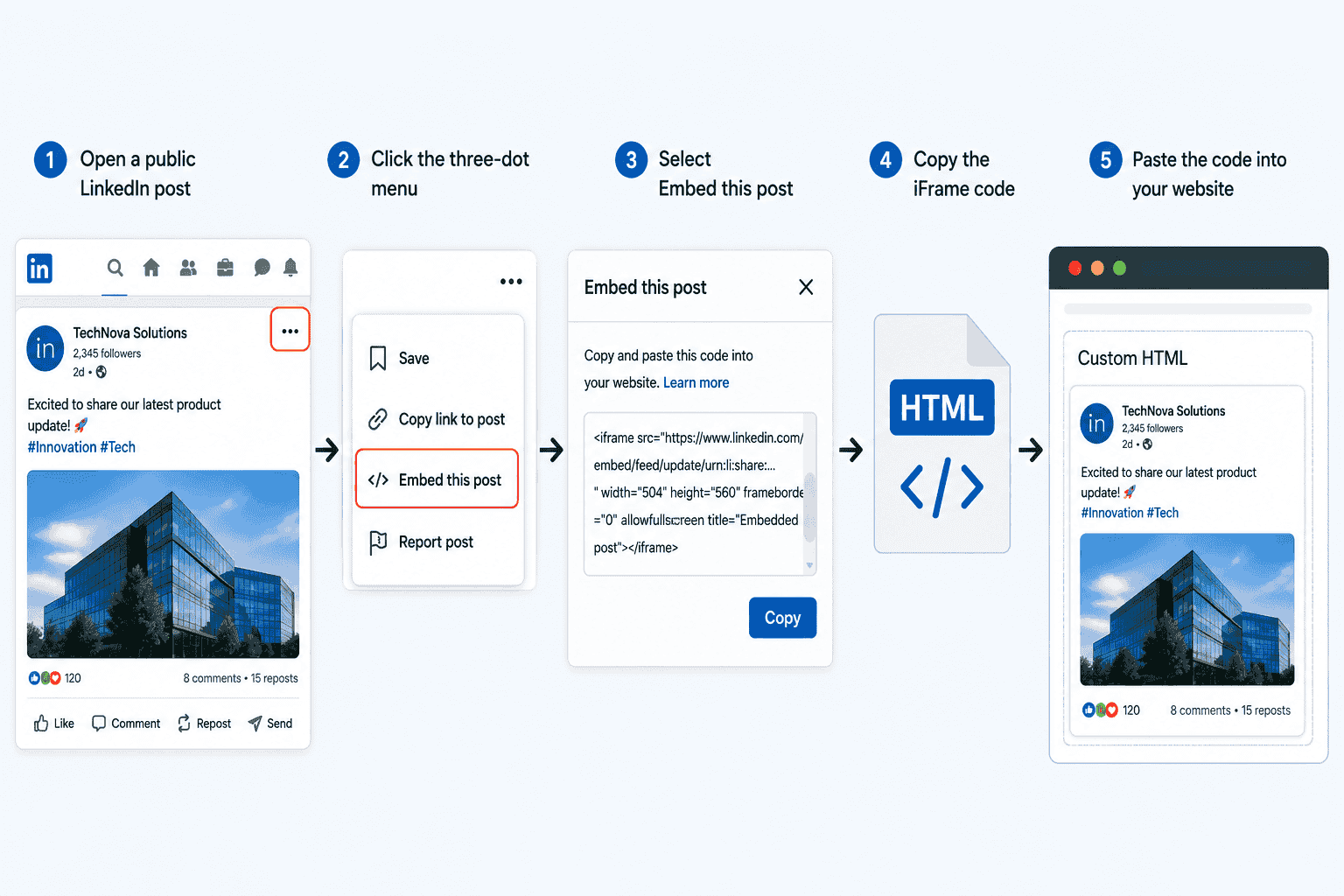
- Open the public post you want to embed, from either a company page or a personal profile.
- Click the three-dot menu in the top right corner of the post.
- Select Embed this post.
- LinkedIn generates an iframe snippet. Copy it.
- Paste that code into your website’s HTML, or into a Custom HTML block if you’re using a page builder.
That’s the whole process, and it costs nothing. But it comes with real limits once you want more than one post showing:
It’s one post per snippet, with no setting to just show your last ten updates. You’d need to repeat the whole process for each one. There’s no auto-updating either. The embed is a snapshot, so if you publish something new on LinkedIn tomorrow, your website won’t reflect it until you manually grab a fresh code. Only public posts qualify, so anything shared to a restricted audience, posted in a Group, or set to connections only simply won’t produce an embed option in the first place. Multi-photo posts and reposts with commentary are excluded too, by LinkedIn’s own design.
On top of that, the embed isn’t responsive by default. It needs a CSS wrapper to behave on smaller screens. And if the original post ever gets deleted, your embed disappears with it. No fallback, nothing you can do about it.
If what you actually want is a page that keeps itself current without you touching it every week, this method runs out of road pretty fast. That’s the gap a feed aggregator fills.
Embed LinkedIn Feed On Website
Collect, Moderate, and Display LinkedIn Company Post On Website
Try For FreeMethod 2: Using A LinkedIn Feed Aggregator For A Live, Auto-Updating Feed
A tool like Tagembed sits between LinkedIn and your website. It pulls in new posts as they go up and pushes them into a single embed code you only need to set up once.
Here’s roughly how it works:
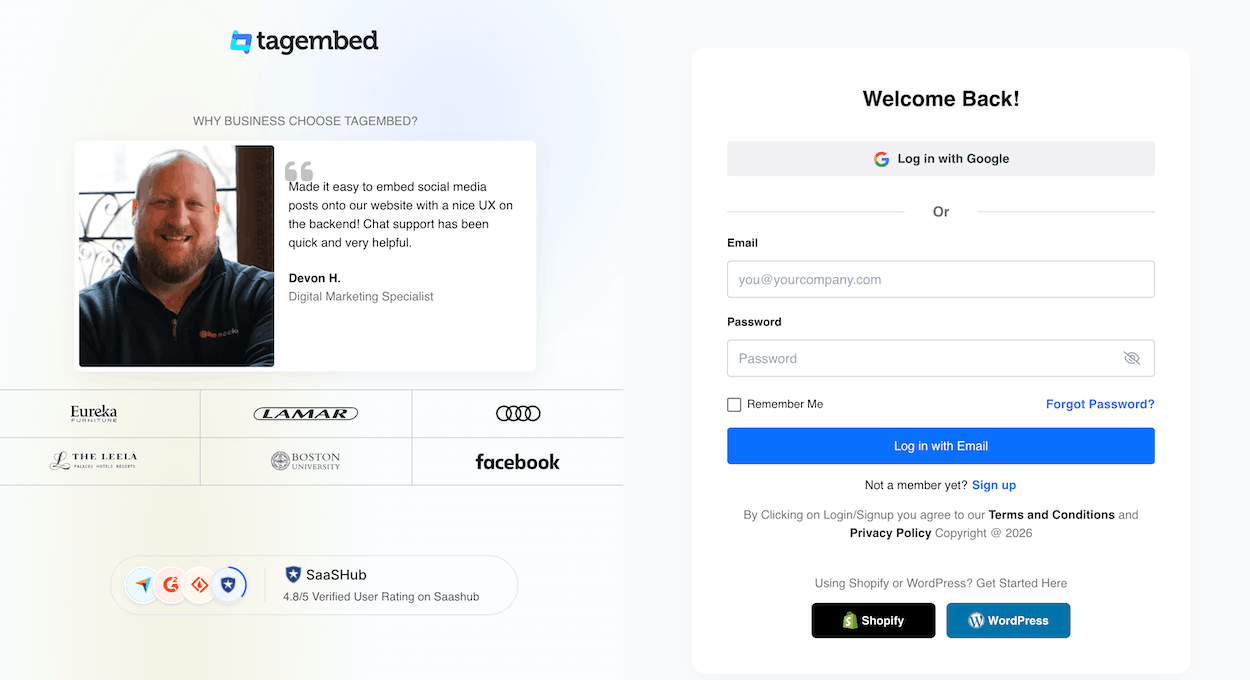
Step 1: Sign up to Tagembed
Create your account for free on Tagembed, then pick “Social Feeds on Websites” from the options on your dashboard.
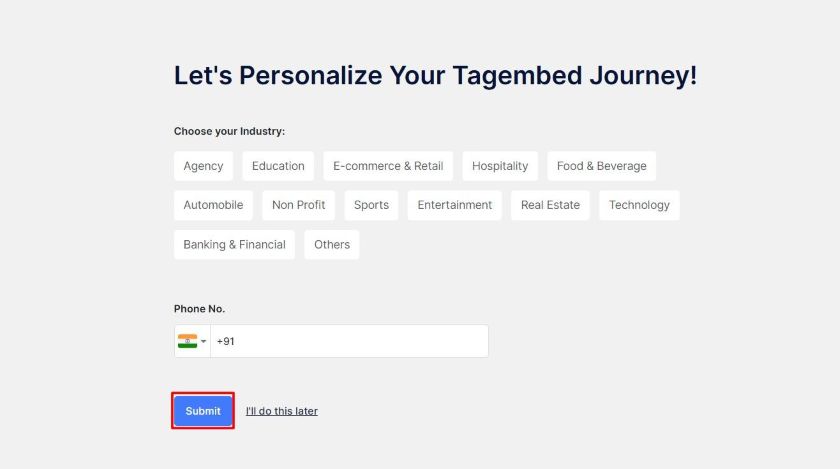
Step 2: Choose your industry
Choose your industry from the provided options on your screen. This just helps Tagembed tailor the setup, and takes a few seconds.
Step 3: Choose Platform
Open the Content Gallery panel on the left and select LinkedIn as your source network. You’ll be asked to choose between pulling in an entire company page or a single post by URL. For an auto-updating feed, go with the company page (or profile) option.
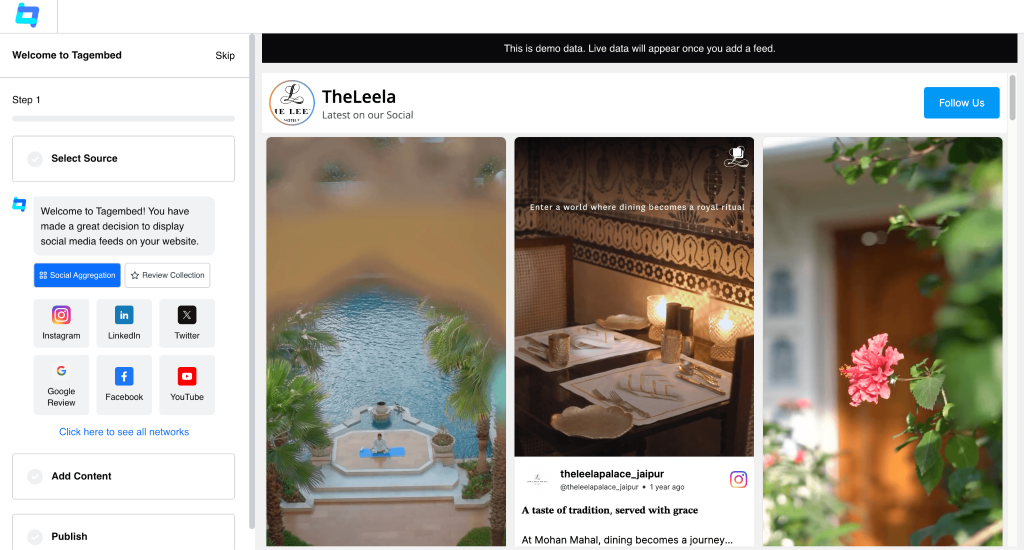
Make sure to authenticate your LinkedIn account so Tagembed has permission to pull the content, then hit “Create Feed.”
Step 4: Moderate and style the feed.
Moderate the content by manually selecting the content you want to showcase. Click on the “Auto Pilot” button to use AI Moderation and set rules for the content. Head to “Publish” and select Website as your channel. From there, the Theme tab lets you pick a layout like grid or slider, and the Customization tab handles everything else: background, card style, banners, a CTA button if you want one.
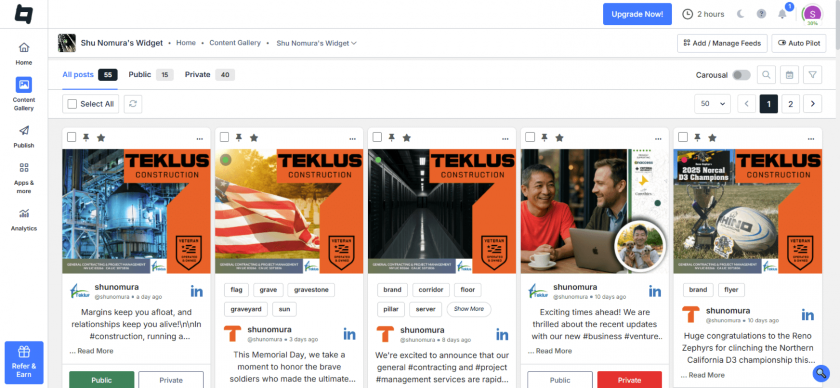
Step 5: Generate your LinkedIn embed code
Choose the gallery type and the platform your site runs on (WordPress, HTML, Shopify, and so on all show up as options here), set the width and height, and copy the code. Paste it into your site once. From here, the feed keeps itself current without you doing anything further.
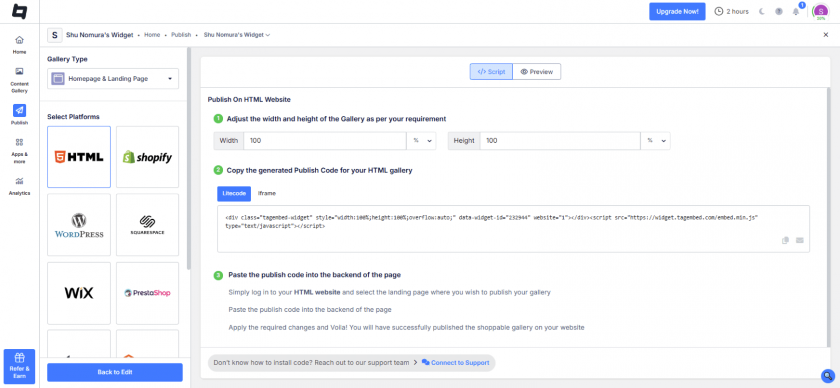
The practical difference from the native option comes down to this: you do the setup once, and it just keeps working after that.
How To Add LinkedIn Feed Embed Code On Different Website Platforms:
The setup on the Tagembed side is always the same: generate your LinkedIn feed, then use the platform dropdown in the code-generation step to get a snippet tailored to your site builder. What happens after you copy that code is where each platform differs.
1. How to Embed a LinkedIn Feed on an HTML Website
A plain HTML site needs no plugin or extra setup, since the snippet just drops straight into the page source.

Here’s the process.
- In the widget editor, click Embed Widget and select HTML as your platform.
- Set the width and height you want the feed to display at.
- Click Copy Code to grab the snippet.
- Open your site’s source and paste the embed code wherever you want the LinkedIn feed to appear.
2. How to Add a LinkedIn Feed To WordPress Website
WordPress gives you two routes here: either pasting the raw code manually or using Tagembed’s dedicated plugin if you’ll be updating the widget often. Both methods let you embed a live LinkedIn widget on your WordPress website without writing any code.

Using the widget code directly (no plugin):
- Generate your embed code in Tagembed with WordPress selected as the platform, set your dimensions, and copy the code.
- In the WordPress block editor, open the page you want it on, click (+) Add Block, and choose Custom HTML.
- Paste the embed code in and click Update or Publish.
- In the older Classic Editor, switch to Text view (instead of Visual) before pasting the code, then click Update.
Using the Tagembed WordPress plugin:
- From your WordPress dashboard, go to Plugins > Add New, search for Tagembed Plugin, then install and activate it.
- Inside the plugin, register or log in to your Tagembed account.
- Go to My Widget, click Add Feeds, and choose LinkedIn as your source.
- Pick Company Page URL to pull posts automatically, or Post URL to add specific posts one at a time, then click Create Feed.
- Open the Display tab to preview the feed and copy the Shortcode. You can adjust the theme and layout from here too.
- On the page or post where you want the feed, click (+) Add Block, select the Tagembed Widget block, and paste the shortcode into it.
- Click Embed, then Update to publish the page.
3. How to Insert LinkedIn Feed Into Shopify Website
Shopify lets you add the feed either to an existing theme template or to a fresh standalone page, depending on where you want it to live. This method displays an auto-updating LinkedIn company feed widget in the Shopify store.

- Generate the embed code with Shopify selected as your platform and copy it.
- Log into your Shopify admin and open the Online Store under Sales Channels.
- Go to Themes, then click Customize on the theme you want to edit.
- In the theme editor’s left panel, find Custom Content and select it.
- Choose the Custom HTML option, paste your code in, and save.
- Reload the live page to confirm the feed is showing.
- If you’d rather add the feed to a brand-new page instead, go to Sales Channels > Online Store > Pages, click Add Page, use the embed icon (<>) in the page editor, and paste the code there instead.
4. How to Include LinkedIn Feed On Squarespace Website
Squarespace requires the code to go into a dedicated embed block rather than a general text section. Follow these steps to add it correctly.

- Choose Squarespace as your platform and generate the embed code from Tagembed.
- Go to the page in your Squarespace site where the feed should appear.
- Click Add Block (or edit an existing block).
- Select Embed from the block menu.
- Click the </> code icon inside the URL field, then paste your Tagembed code there.
- Save your changes.
5. How to Insert LinkedIn Feed Into Elementor Website
If you’re building pages with Elementor, the feed goes in through its HTML widget rather than the standard WordPress editor. Here’s the process.

- Set your platform to Other in Tagembed and copy the generated code.
- Log into your WordPress site with Elementor installed and open the page or post you’re editing.
- In the Elementor panel, drag an HTML widget onto the page (or select one already placed there).
- Paste the embed code into the widget.
- Save your changes and reload the page to confirm the feed is showing.
6. How to Integrate LinkedIn Feed Into Wix Website
Wix handles embeds through its iFrame element rather than a plain code block, which trips people up the first time. These are the steps to follow.

- Generate your embed code with Wix selected as the platform.
- In the Wix editor, click Add in the left menu bar.
- Choose More, then look under Embeds for HTML iframe.
- Paste your code into the field provided.
- Click Apply to save the changes and bring the feed live.
7. How to Add LinkedIn Feed To Weebly Website
Weebly’s editor uses its own embed panel, separate from its standard content elements. Here’s how to add the feed.

- Select Weebly as your platform and generate the code from Tagembed.
- Open the page in your Weebly editor where you want the feed to appear.
- Drag an Embed Code element onto the page.
- Click into the HTML box and choose Edit Custom HTML.
- Paste the copied code into the box.
- Save and publish your changes.
8. How to Embed LinkedIn Feed On Webflow Website
Webflow renders embeds live inside the Designer, so you can preview placement before publishing anything. Here’s how to set it up.

- Set your platform to Other in Tagembed and copy the code.
- Log into your Webflow account and open the page you’re working on.
- Use Add Element and select Embed from the options.
- Drag the Embed block onto the section where the feed should sit.
- Paste the copied embed code into the embed field.
- Click Save or Publish, then reload the page to check that the feed is live.
9. How to Insert LinkedIn Feed Into Blogger
Blogger requires switching the post editor into HTML view before the code will paste in correctly. Follow these steps.

- Choose Other as your platform in Tagembed and copy the embed code.
- Log into your Blogger dashboard.
- Open the post or page where you want the feed.
- Switch the editor to HTML view.
- Paste the embed code in at the spot where the feed should appear.
- Save or update the post, then reload the live page to confirm it’s working.
10. How to Include LinkedIn Feed On SharePoint
SharePoint uses its own web part system, so the widget goes into an Embed web part rather than a standard content section. Here’s the process.

- Copy your embed code with others selected as the platform.
- Log in to your SharePoint admin account and open the page you want to edit.
- Click Edit to enter the page editor.
- Add an Embed web part to the section where the feed should go.
- Paste the copied code into the web part.
- Click Apply, then publish or save the page.
Whichever platform you’re using, embedding a LinkedIn feed follows the same workflow: generate the widget, copy the embed code, paste it into a Custom HTML, Code, or Embed block, and publish your page. Once connected, your LinkedIn company page feeds update automatically, so your website always displays your latest posts.
11. How to Embed LinkedIn Feed on Confluence Page
Confluence lets you display a live LinkedIn feed using the HTML Macro (for Data Center/Server) or an HTML/embed app from the Atlassian Marketplace (for Confluence Cloud). Once added, your LinkedIn profile widget updates automatically without requiring you to manually refresh the page.

- Generate your LinkedIn feed in Tagembed and select Other as your platform.
- Copy the generated LinkedIn embed code.
- Open the Confluence page where you want to display the LinkedIn feed and click Edit.
- Insert an HTML Macro (Confluence Data Center/Server) or the HTML/embed app available for your Confluence Cloud instance.
- Paste the copied embed code into the HTML field.
- Save the macro, then Publish or Update the page.
Your LinkedIn feed will now appear on the Confluence page and automatically display your latest company updates, making it easier to share announcements, thought leadership, and company news with your team from a single location.
Collect, curate, & embed LinkedIn company profile feed on website.


LinkedIn Native Embed vs. Third-Party Feed Aggregator:
| Feature / Method | Native LinkedIn Embed | Third-Party Feed Aggregator (Like Tagembed) |
| Cost | 100% Free | Free plan / Paid tiers |
| Content Type | Single post only | Live, Multiple Posts |
| Setup Complexity | Very Low (copy/paste) | Low (requires account setup) |
| Custom Styling | None (Fixed layout) | High (Grid, Slider, Carousel) |
| Best For | Highlighting 1 announcement | Displaying ongoing company activity |
| Content Moderation | No | Yes (Filter and Hide Posts) |
| Updates Automatically | No | Yes (Live Feed) |
| Device Responsive | Limited responsiveness | 100% Mobile Optimized |
| Analytics | Not Available | Track clicks & engagement |
Real-World Examples of Websites Embedding LinkedIn Feeds:
Many businesses use Tagembed’s LinkedIn feed widget to display live company updates, strengthen social proof, and keep their websites fresh with automatically updated content. Here are a few real-world examples.
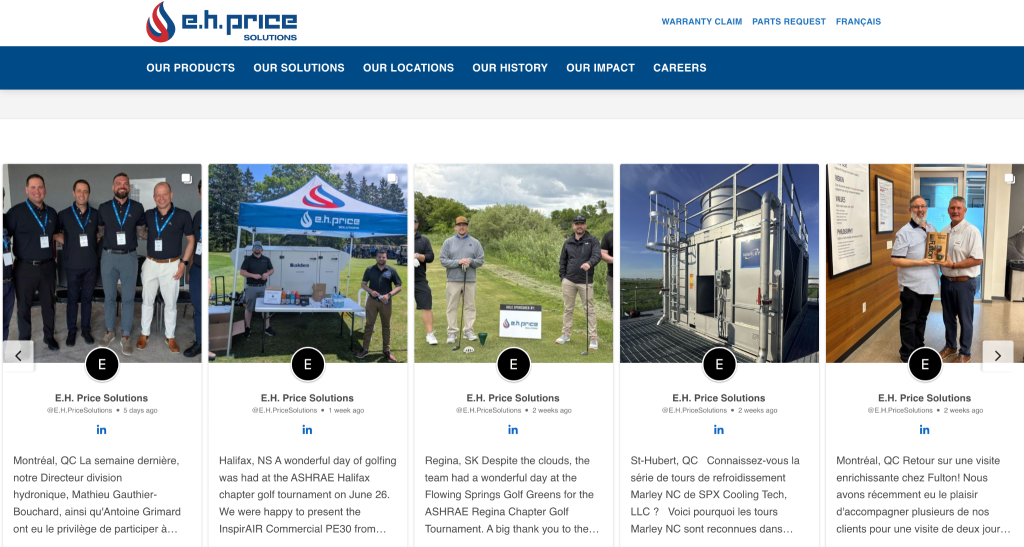
1. E.H. Price Solutions
E.H Price solution is a Canadian HVAC and mechanical products distributor operating 20-plus locations coast to coast, runs a dedicated “Our Insights” section on its homepage built around a live LinkedIn feed. For a company selling to engineers, contractors, and commercial building owners, that section does double duty: it signals an active, established business to prospective B2B buyers doing due diligence, and it surfaces company news and project wins without anyone needing to maintain a separate blog.
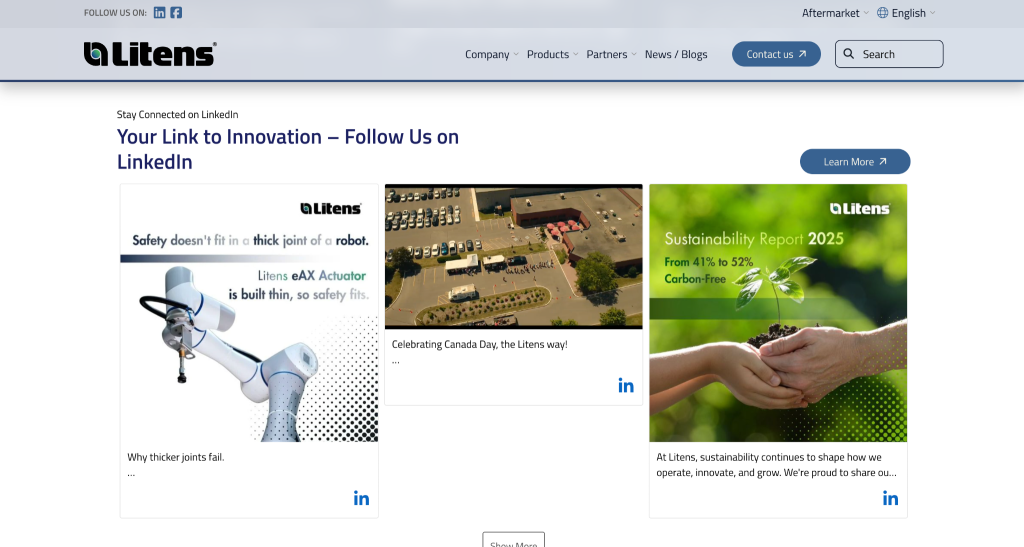
2. Litens
Litens is a global automotive technology manufacturer with facilities across multiple countries and runs a careers-heavy site with a steady stream of company news, from sustainability reports to plant visits and industry awards. For a manufacturer this size, hiring engineers and technical talent across regions, a live LinkedIn feed on a careers or news page is a natural fit, since it gives site visitors a rolling view of company culture and activity without a content team rewriting the homepage every month. We couldn’t confirm from Litens’ public site whether a widget is currently live there, but the business profile is exactly the kind that tends to get real use out of one.
3. Tax Admin:
The Federation of Tax Administrators has embedded its LinkedIn feed in its careers section. This gives them the opportunity to add visually appealing images on their website without using any extra time or resources. It also helps them get potential recruits among the new website visitors.

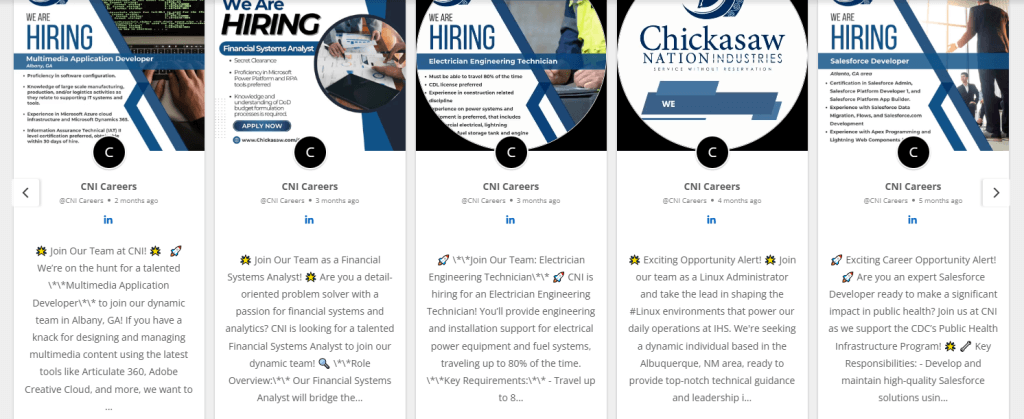
4. Chickasaw:
Chickasaw is a large-scale company that helps businesses accomplish desired infrastructure and optimization in terms of their mission. The brand uses LinkedIn as its primary recruitment channel, posting all new openings on the platform. They’ve also embedded all the posts about hiring on their “Careers” page to get potential employees among their usual traffic. The visitors get all the information about the hiring process via the LinkedIn post, making it easy for them to apply.
Getting More Out Of Your Embedded Linkedin Feed:
A few habits separate a feed that actually helps from one that just sits there taking up space.
Filter before you publish, not after. A raw, unfiltered feed can surface posts you’d rather not spotlight on a landing page, like old hiring pushes or off-topic reshares. Setting keyword filters upfront saves you from policing the feed by hand later. Keep an eye on page performance too. Stacking several native LinkedIn iframes on one page means loading LinkedIn’s scripts and styles multiple times over, which slows things down. A single aggregator-rendered widget avoids paying that cost repeatedly.
Placement matters more than people expect. Homepages, About Us pages, and careers pages tend to get the most out of a live feed, since visitors there already want to know who you are. Test it on mobile before calling the job done, and take a few extra minutes to match colors and fonts to your site. A feed that clashes visually reads as an afterthought, even when the content itself is good.
Common Issues And How To Fix Them:
Even the best embedding tools can run into occasional hiccups. The good news? Most issues are easy to fix in just a few minutes.
1. The widget shows nothing.
Check that your LinkedIn source is properly connected and authorized, and that the account has admin access to the page you’re pulling from. Some widgets take up to a minute to import posts the first time, so give it a moment before assuming something’s broken.
2. Posts aren’t updating.
This is usually a caching issue rather than a problem with the social media widget itself. Clear your site’s cache and any CDN cache like Cloudflare, then refresh.
3 . The embed looks broken on mobile.
Native LinkedIn embeds aren’t responsive out of the box and need a CSS wrapper. Aggregator widgets are typically responsive by default, so this is often a sign you’re leaning on the native single-post method at a scale it wasn’t built for.
4. A post vanished from the feed.
If the original author deleted or restricted the post, it drops out of the feed. There’s no fix for this on your end, since the content itself no longer exists on LinkedIn.
Conclusion
LinkedIn’s native embed works well for quoting a single post, but it won’t give you a feed that updates on its own. For that, you need an aggregator sitting between LinkedIn and your site. Every major platform, from WordPress to Shopify to Webflow to plain HTML, supports pasting in an embed code, even though the exact steps differ slightly. And once it’s live, filtering, mobile testing, and placement do more for how well the feed performs than most people assume going in.
FAQs
Yes. LinkedIn’s native embed option costs nothing and has no post limit, though it only handles one post at a time. Tools like Tagembed also offer free plans for a live, auto-updating feed at a smaller post count, with paid tiers for higher volume and full customization.
Only posts marked Public can be embedded. Anything shared to a restricted audience, posted inside a LinkedIn Group, or set up as a multi-photo post or a repost with commentary won’t produce an embed option at all.
It can, indirectly. Fresh, regularly updating content and longer time on page are both things search engines tend to reward, and a live feed gives you both without adding to your content workload.
Yes, both work the same way, whether you’re using the native embed or an aggregator tool, as long as the profile’s posts are set to public.
Native embeds need a manual CSS wrapper to behave on smaller screens. Widgets from feed aggregators are generally mobile-responsive by default.
No. Both the native embed and aggregator widgets hand you a copy-paste snippet. Page builders like Elementor, Webflow, and Wix have dedicated blocks for pasting it in, and WordPress users can skip code entirely with a plugin.
Embed social feed from Facebook, YouTube, Instagram, Twitter on your website, like a PRO
Invalid Email Address Multiple Themes